Reviewing Pull Requests: What to Check, What to Say, When to Close
A review has two readers: the person who wrote the code, and whoever reads the thread in three years to understand why. Write for both. Here’s what to check, how to label each comment so the author knows what’s blocking, and when to close instead of asking for another round.
Ten seconds before the diff#
Reading a diff takes minutes; deciding whether to read it takes seconds. Before you open Files changed:
- Is there an issue, and does the pull request say which? Without one, you’re reviewing a decision nobody made.
- Is it in scope? A well-written feature the project doesn’t want is still a no. Saying No has the replies.
- Does it do what the title says, and only that? Three unrelated changes are three pull requests.
- Is CI green, and did the author fill in the template? If not, say so in one line and wait: it’s the author’s turn.
What to check in the diff#
A review checklist keeps you from checking the style and missing the bug. Copy this one into your review when it helps:
- It fixes the issue, all of it and only it.
- A bug fix comes with a test that fails without the fix.
- Docs, examples and the changelog follow the change in behavior.
- No breaking change hides in it: public API, options, defaults, output format.
- Anything visible works with a keyboard and a screen reader, and new strings can be translated.
- It’s small enough to review in one sitting.
- CI is green, on the checks that matter for this change.
Ask to split anything much over 400 changed lines. A SmartBear study of a team at Cisco found that reviewers find fewer defects beyond 200 to 400 lines at a time. A big pull request gets a skim, not a review, and both of you know it.
Label every comment#
The same sentence can be a blocker or a passing thought, and the author can’t tell which. Say it. Conventional Comments gives each comment a label, and the author a clear next step:
| Label | What it means | What the author does |
|---|---|---|
praise: |
Something done well. | Nothing. Keep doing it. |
nitpick: |
A detail of style or taste. Never blocks the merge. | Fix it or leave it, and say which. |
suggestion: |
A proposed change, often as a suggestion block. | Apply it, or explain why not and let the maintainer decide. |
question: |
The reviewer doesn’t understand something. | Answer it. Change the code only if the answer shows a problem. |
issue: |
A problem that has to be solved before the merge. | Fix it, or discuss it in the thread. |
(blocking) or (non-blocking) after the label settles the rest: suggestion (non-blocking): … can wait for another pull request.
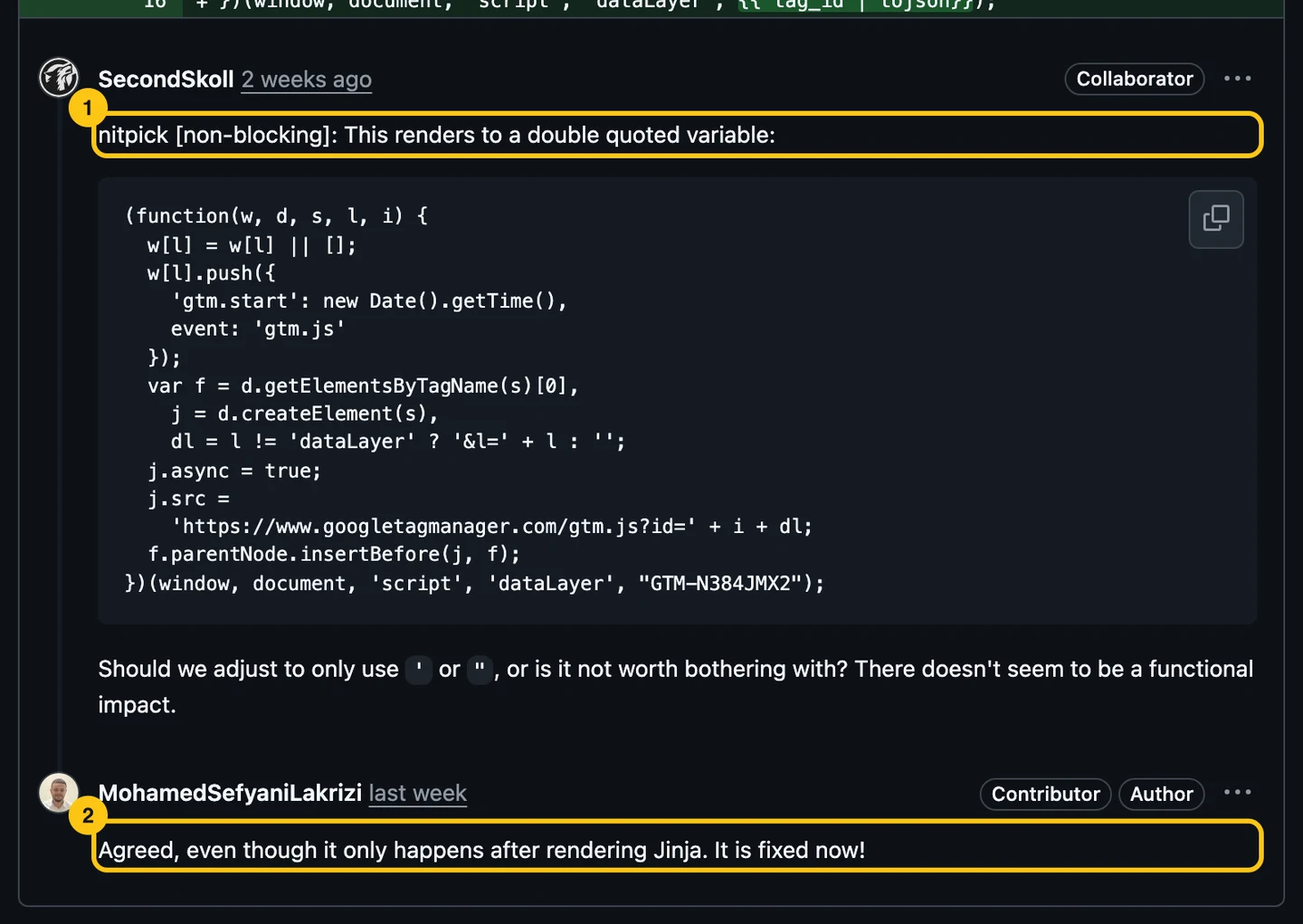
In a Canonical documentation theme, a reviewer flagged a quoting detail as nitpick [non-blocking] (1). The author fixed it anyway, and said so (2):
Label the good parts too. One praise: on the part that was done well costs a line, and tells the author what to keep doing.
Send one review, not twenty comments#
Every comment you post on its own sends a notification. Click Start a review instead of Add single comment, write all your comments, then submit them together with a verdict: Comment, Approve or Request changes.
- Use suggestion blocks for small changes: the Add a suggestion button in the comment toolbar turns your fix into one the author applies with a click. Your First Contribution shows one from the author’s side.
- Approve with nits when only nits are left: “Approved. Two nitpicks below, take them or leave them.” Another round for a missing period costs the contributor a day.
- Fix the last details yourself when “Allow edits by maintainers” is ticked, and say what you changed.
Write the comment you’d want to receive#
Review the code, not the person. Ask before you assert: you may be missing the reason.
Why would you do it like this? This is wrong.
question: why a new helper here? formatDate() in utils.ts looks like it does the same, unless I’m missing a case.
You forgot the tests.
issue (blocking): this changes the output for empty strings. Could you add a test for that case? The others are in
tests/format.test.ts.
- “Could you” and “what about” leave room for a better idea. “You should” doesn’t.
- “This is called twice” says the same as “you’re calling this twice”, without pointing at anyone.
- Be specific about what “done” looks like. “Needs work” is not a review.
Close in a day rather than ghost for a year#
A pull request you won’t merge doesn’t get better by waiting. Close it with the reason, as soon as you know. On twbs/bootstrap#42911, a pull request that touched Sass variables in Bootstrap 5 just before the Bootstrap 6 alpha, Julien closed it the day after it was opened:
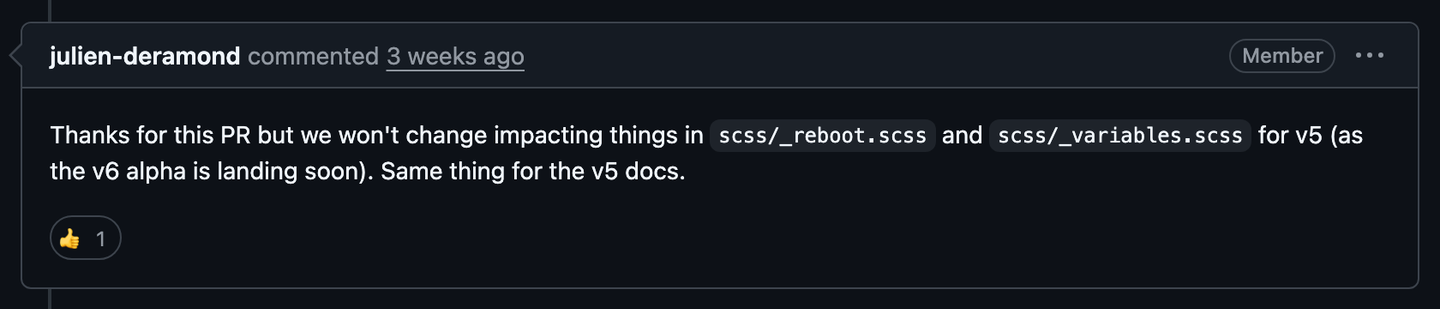
The author answered “Makes total sense, thanks for taking a look!” and offered to check the same values on the v6 branch instead. A clear no, within a day, kept a contributor. The four common reasons, with a reply for each:
-
Out of scope: the replies in Saying No.
-
Superseded:
Closing this in favor of #123, which fixes the same thing and was further along. Thanks for the work: (what from this pull request was used, if anything). -
No response:
Closing, since this has waited for changes for (N) weeks. No problem at all: if you come back to it, reopen it or open a new one, and we'll pick up where we left off. -
Too far off:
Thanks for the effort. This would need a rewrite more than a review: (the main reasons). I'm closing it so that it doesn't sit here. If you want to try again, start from (issue or approach), and comment on the issue before you write code.
Merge so that the history tells the story#
Squash, and rewrite the commit message. The branch’s “fix typo” and “address review” commits help nobody later. The squashed commit’s first line is what git log and the changelog show: say what changed, in the project’s format. When Julien merged stefan-korn’s first contribution, he replaced the issue’s title with “Docs: Add .table class to color tables example”.
Keep every author. Check the end of the message before you confirm: everyone who wrote code on the branch needs a Co-authored-by: line to be credited on GitHub. That squashed commit, a715174, shows both stefan-korn and Julien as authors. To credit reviewers and people who helped in the thread too, Better GitHub Co-Authors adds a button to the merge box that collects them.
Label for the release notes. GitHub generates release notes from merged pull requests, grouped by label. One label at merge time saves writing the changelog later.
Share the load#
One maintainer reviewing everything is a queue, and eventually a burnout. Spread it:
-
A
CODEOWNERSfile requests reviews automatically, by path. Bootstrap’s has three lines:*.js @twbs/js-review *.css @twbs/css-review *.scss @twbs/css-reviewA pull request that touches Sass requests a review from the CSS team, as a code owner, without anyone asking:
-
Rotate within the team. GitHub assigns team reviews round robin or by load, so the same person doesn’t get every request.
-
Make sure a ping finds someone. This guide tells contributors to ask once after two weeks of silence. Watch the repository, or at least its pull requests, so that the ping reaches a person.

Review AI-assisted pull requests like any other#
A pull request written with an AI tool gets the same review, and the same bar. curl’s contribution guidelines accept AI-assisted code as long as it follows every normal requirement, and put the burden on the author. What changes is the question to ask: can the author explain the change in their own words? If they can’t answer a question:, close it with the “too far off” reply. To write the rules down for contributors, start from a policy you can copy.
Do this now#
- Add a
CODEOWNERSfile to your project, even with one line. - Save the three closing replies above in your GitHub settings.
- Close the oldest open pull request you know you won’t merge, with the reason.
- In your next review, label every comment, and add one
praise:.
Go further#
- Conventional Comments: the full list of labels and decorations, with examples.
- About pull request reviews: every button a reviewer can press, from GitHub’s docs.
- Saying No: the replies for pull requests that shouldn’t be merged at all.
- Your First Contribution, Step by Step: the same review, from the contributor’s side.