CLA or DCO: What You Sign When You Contribute
When you open a pull request, you license your code to the project. Most projects rely on their own license for that, some ask for a one-line sign-off in each commit (a DCO), and some for a signed agreement (a CLA). Here’s what each one gives the project, what to read before you click “I agree”, and which one to ask for when you’re the maintainer.
Without a signature, inbound equals outbound#
A project doesn’t need you to sign anything to use your code. GitHub’s terms of service settle it for every repository with a license: when you contribute to one, “you license that Content under the same terms” (section D.6). The clause names the principle: “inbound=outbound”. The license you receive the code under is the license you contribute under.
It also says what overrides it: a separate agreement, “such as a contributor license agreement”. That’s the choice every project makes, on purpose or not:
| The project asks for | You give | Used by, as of September 2026 |
|---|---|---|
| Nothing | Your code, under the project’s license | Most projects on GitHub |
| A DCO sign-off in each commit | The same, plus a statement that you may contribute it | Linux, Git, GCC, Node.js, OpenTofu, Valkey |
| A signed CLA | A license to the project’s owner, often a wider one | Google, Microsoft, Meta, Kubernetes, CPython, HashiCorp, Elastic |
Django asked whether it still needed its CLA, and made it optional on February 9, 2026: “It’s not clear that CLAs are needed”, given inbound=outbound. Contributors whose employer requires one can still sign it.
A DCO is one line: you may contribute this code#
The Developer Certificate of Origin started in the Linux kernel. Linus Torvalds proposed it in May 2004 “to document that chain of trust”, after SCO’s lawsuits had questioned where Linux code came from, and version 1.1, the current one, went in on June 14, 2005. The full text is four short clauses. By signing off, you certify that:
- you wrote the code and may submit it under the project’s license, or
- it’s based on earlier work under a compatible open-source license, or
- someone who certified one of the above gave it to you, unchanged;
- and you understand that the contribution and your sign-off are public, and kept.
The sign-off is a line in the commit message, with your name and email:
Fix the timeout on slow connections

Signed-off-by: Ada Lovelace <ada@example.com>
git commit -s adds it from your user.name and user.email (Git’s docs). Git has no setting to do it by default, on purpose: signing off is a statement you make for each commit.
Projects check it with the DCO GitHub App. A commit without a sign-off, or with one that doesn’t match the commit’s author, stops the pull request with a check that asks for action, and explains the fix:
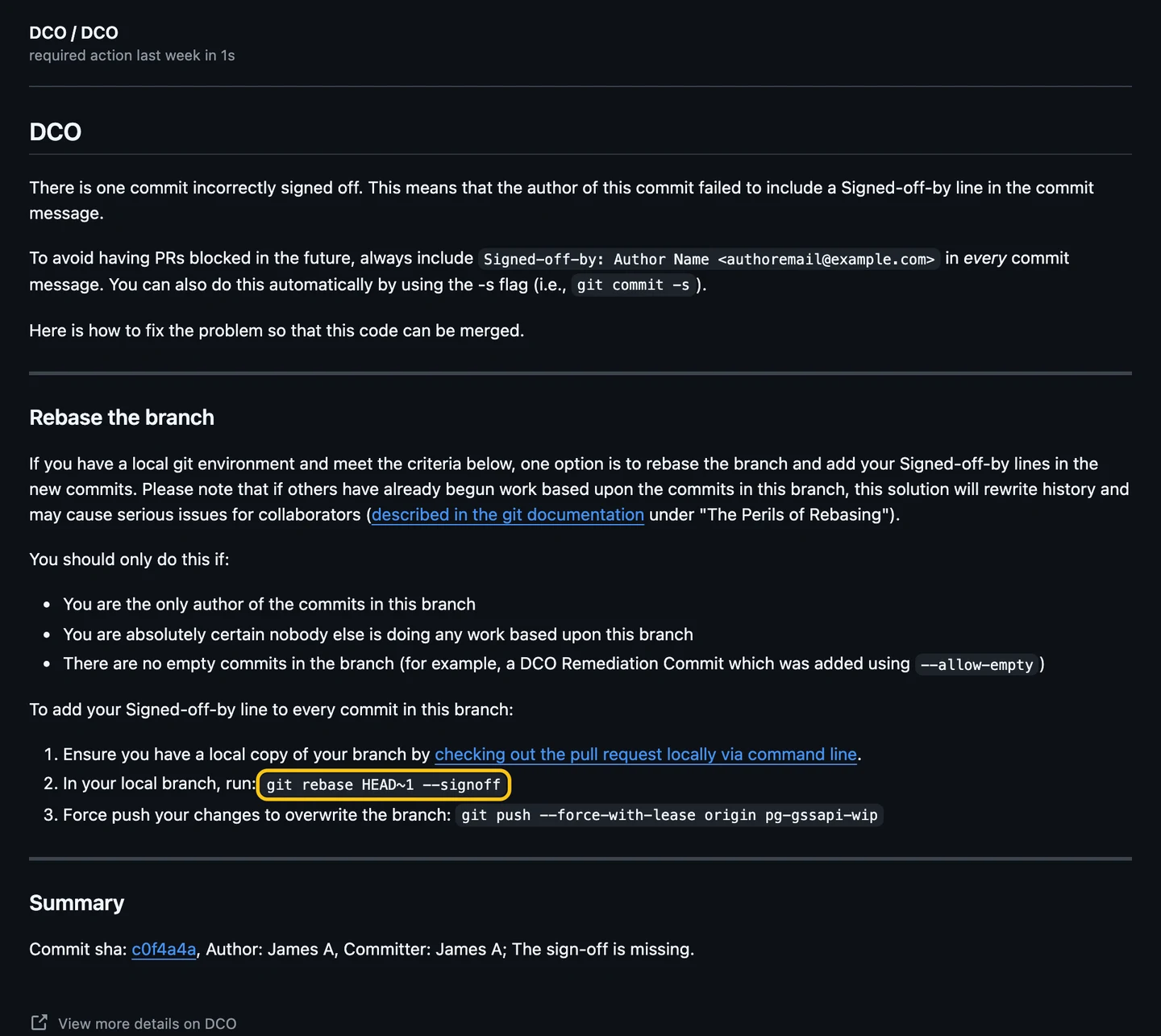
git rebase --signoff adds the missing line to every commit of your branch (Git’s docs); force-push the branch afterwards. For commits made in GitHub’s web editor, maintainers can require a sign-off in the repository settings. It doesn’t cover commits pushed from the command line: that’s what the app is for.
Several projects dropped their CLA for a DCO: Chef (October 3, 2016), GitLab (November 1, 2017) and Spring (January 6, 2025). Node.js, which had the DCO text in its contributing guide for years, made the sign-off required in April 2026.
A CLA is a license to the owner, often a wider one#
A contributor license agreement is a contract between you and the project’s owner: a company, or a foundation. The reference text is the Apache Software Foundation’s individual CLA, which most others adapt. It grants the foundation:
- a copyright license on your contribution: “perpetual, worldwide, non-exclusive, no-charge, royalty-free, irrevocable”, with the right to sublicense;
- a patent license on your patents that the contribution uses;
- and nothing else: “You reserve all right, title, and interest” in your contribution. You keep your copyright.
When you contribute on your employer’s time, your employer may own the code, and a corporate CLA (CCLA), signed by the company, covers its employees. Ask before your first contribution, not after.
A bot checks the signature on each pull request. CLA Assistant, a free service run by SAP, is the common one: it comments, links the agreement, and you sign with your GitHub account.
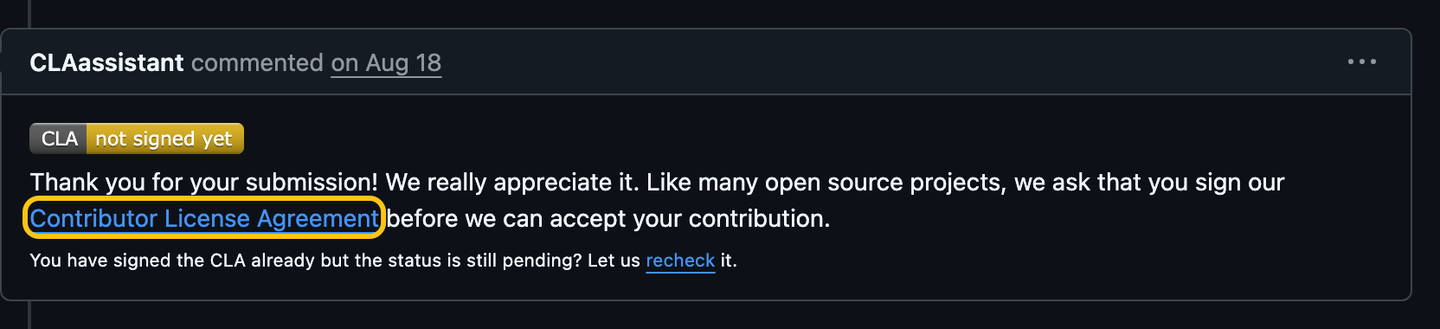
The large projects run their own: Google’s, Microsoft’s and Meta’s bots, and the Linux Foundation’s EasyCLA, which Kubernetes uses. Kubernetes asks for both: the CNCF’s charter requires a DCO sign-off on all code, and each project may add a CLA on top.
Some agreements go further and assign your copyright to the owner. The Free Software Foundation asked for that on GNU projects for decades, so that it could enforce the GPL as the copyright holder. GCC stopped requiring it on June 1, 2021, and glibc followed in August 2021; both accept a DCO sign-off instead.
The right to sublicense is the right to change the license#
A project under a copyleft license can only move to other terms with every contributor’s agreement (Relicensing explains why). A CLA that grants the right to sublicense is that agreement, signed in advance.
HashiCorp’s CLA grants it the right to “sublicense, and distribute Your Contributions” (HashiCorp CLA). On August 10, 2023, HashiCorp moved Terraform from the MPL to the Business Source License, which isn’t open source. Redis went the other way round: its contributing guide said contributions came under the Redis license, and the same commit that moved Redis to RSALv2 and SSPL on March 20, 2024 replaced that sentence with a CLA.
A CLA isn’t a plan to relicense: Apache’s grants the same right, to a foundation that releases all its software under the Apache License. It’s the option. When a company owns the project, read its CLA as the terms your code may one day be distributed under.
Before you click “I agree”#
Read the agreement once per project. It’s usually two pages, and three questions cover it:
- Do you keep your copyright? A license is the norm; an assignment gives the code away.
- Can the owner distribute your code under other terms? Look for “sublicense” or “any license”. If the owner is a foundation with an open-source mission, that’s how it’s meant. If it’s a company, see the section above.
- Does your employer need to sign? If you write the code at work, or your employment contract covers code you write at home, ask before you sign as an individual.
Then decide. Not signing is fine: the pull request won’t be merged, and that’s the whole consequence. Many contributors sign anyway, for a project they want to improve. Both are decisions made with the facts.
For a DCO, check your commit email: the sign-off is public and kept forever, per clause 4. Use the address you want attached to your name, the same as your commits’ author.
As a maintainer, pick the DCO unless you have a reason#
- Nothing at all works for most projects: inbound=outbound already gives you a license to every contribution.
- The DCO adds a record, per commit, that the contributor says they may contribute the code. It costs one app, one line in your
CONTRIBUTING.md, and a rebase for first-time contributors who forget. - A CLA makes sense when a company or a foundation needs a patent grant from contributors, or plans to sell the same code under a commercial license (dual licensing). It needs a lawyer to write it, a bot to check it, and contributors willing to sign it. Say in your contributing guide why you ask for it: contributors will read it anyway.
Decide before the first outside pull request. A CLA added later only covers contributions made after it. The ones before stay under inbound=outbound, and changing their license needs those contributors, one by one.
Do this now#
- Set
git config --global user.emailto the address you want in public sign-offs, and check that GitHub links it to your account. - Before your next contribution to a company-owned project, read its CLA and answer the three questions above.
- If you contribute at work, find out whether your employer has signed a corporate CLA with the projects you contribute to.
- If you maintain a project, write down in
CONTRIBUTING.mdwhat contributors agree to: inbound=outbound, a DCO sign-off, or a CLA, and why.
Go further#
- developercertificate.org: the DCO’s full text, shorter than this section.
- The Apache individual CLA: the reference text most other CLAs start from.
- CLA vs DCO for Django contributors: a project weighing both in public, before making its CLA optional.
- Relicensing: what companies did with the right to sublicense, from MongoDB to Redis.